
How the Academic Success System Helps Students Stay Organized and Achieve Their Goals?
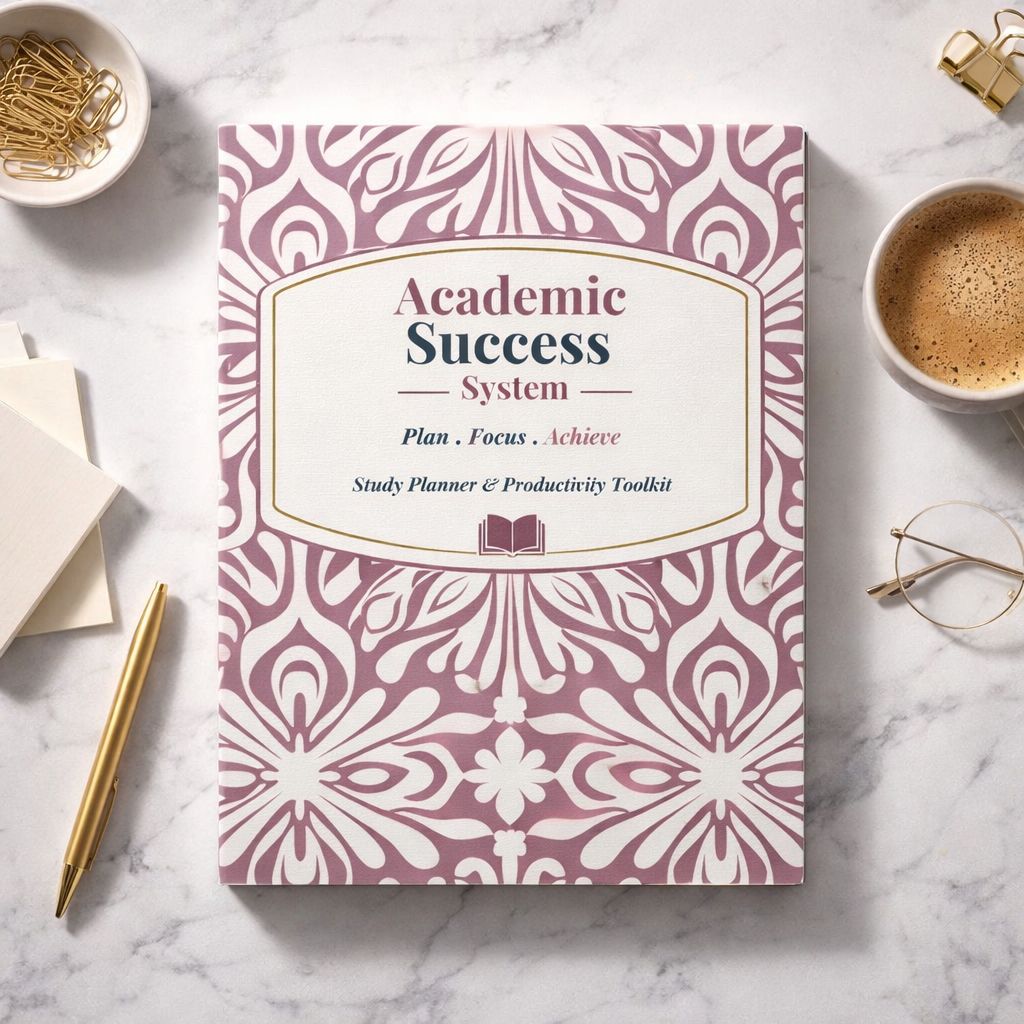
A Comprehensive Guide to Building Better Study Habits, Staying Organized, and Maximizin Academic Performance
Table of Contents
- Introduction: Overcoming Academic Overwhelm
- Part 1: Setting the Foundation & Vision (Orientation Pages)
- Part 2: The Core Operational Engine (6-Month / 30-Week Block Structure)
- Part 3: Growth, Recovery, and Long-Term Retention
- Part 4: Quick Setup Tips & Common Mistakes to Avoid
- Conclusion: Ready to Take the First Step?
1. Introduction: Overcoming Academic Overwhelm
Academic success is rarely the result of luck. It comes from setting clear goals, staying organized, and following a consistent routine. Modern education demands far more than mere memorization, and students today face an unprecedented barrage of distractions and information overload. Traditional planners often fail because they treat time management as a simple list-making exercise.
Enter the Academic Success System—a comprehensive student productivity framework engineered as an end-to-end cognitive workspace. Designed around proven scientific principles (such as Cal Newport's Deep Work, Pareto's 80/20 Rule, and Herman Ebbinghaus's Spaced Repetition curve), this minimalist study system turns raw ambition into a structured daily, weekly, and monthly rhythm of high performance.
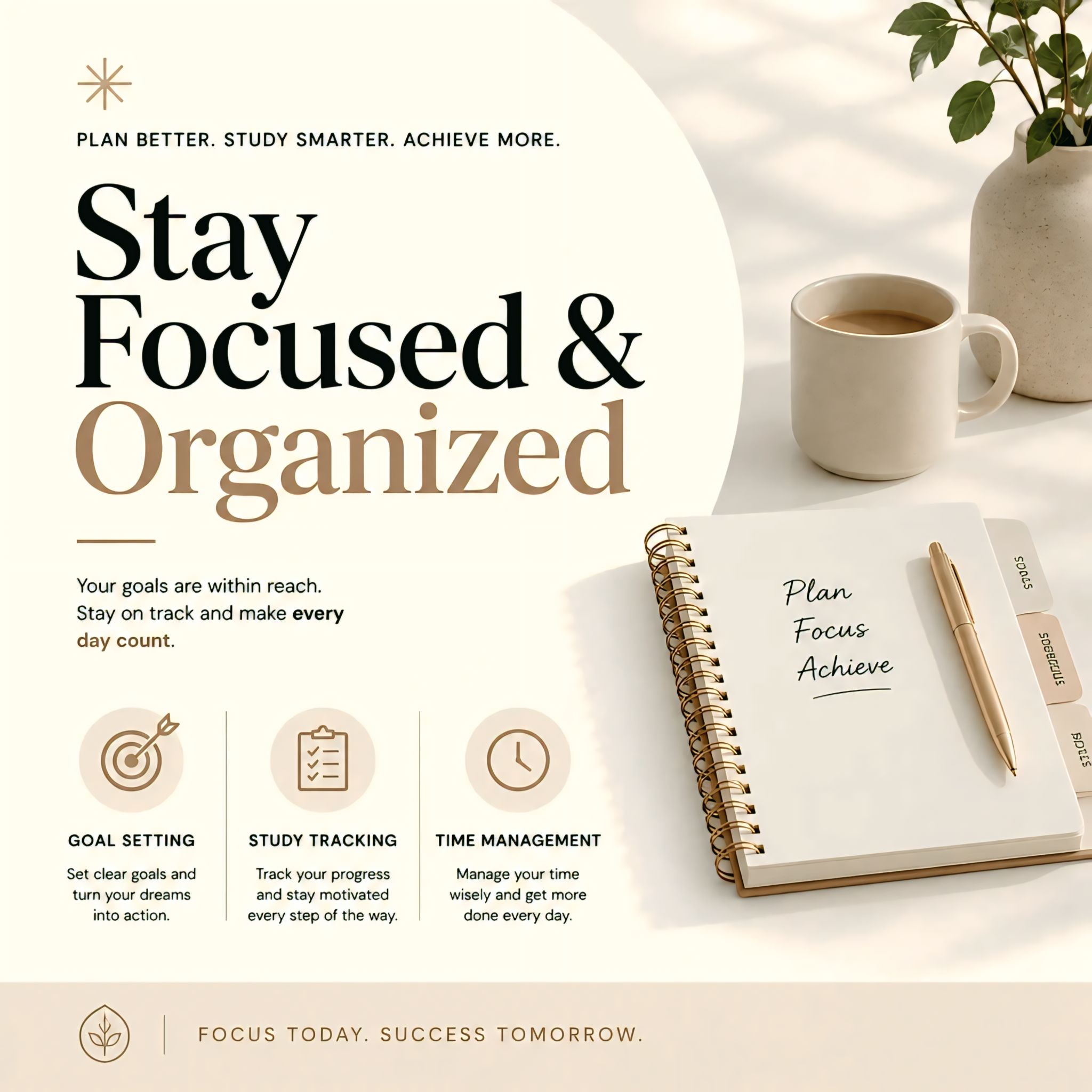
2. Part 1: Setting the Foundation & Vision (Orientation Pages)
Every successful academic journey begins with knowing where you want to go. The opening pages of the planner establish psychological ownership and long-term strategic direction:
- This Planner Belongs To: Establishes personal accountability and ownership.
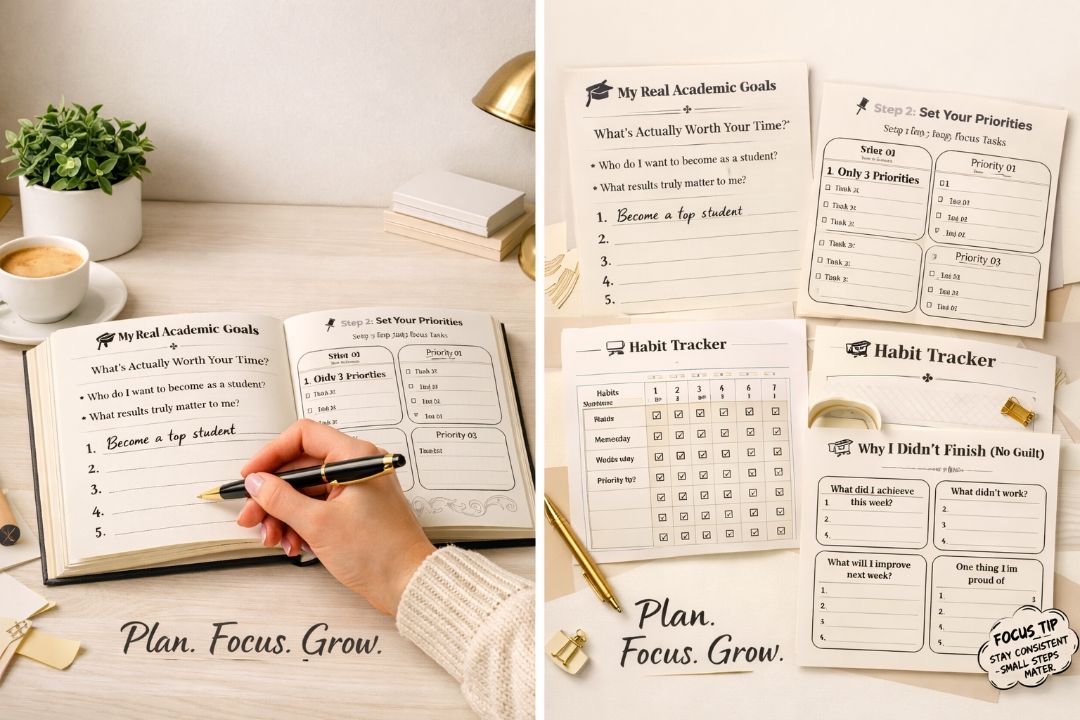
- Your Success Roadmap & My Real Academic Goal: Guides you to define clear, SMART academic goals rather than vague wishes, giving purpose to every study session.
- Set Your Priorities & Find Your Way: A filtering mechanism based on the Pareto Principle (80% of results stem from 20% of efforts) to eliminate decision fatigue.
- Stay on Track & Focus System Intro: Core guidelines and modular productivity strategies (Time Blocking, Pomodoro, Deep Work) to maintain consistency and resist procrastination.
Key Takeaway: By anchoring your daily actions to a clear roadmap, you ensure that every hour spent studying is aligned with your ultimate academic vision.
3. Part 2: The Core Operational Engine (6-Month / 30-Week Block Structure)
Having clear goals is only the beginning. Real success comes from turning those goals into consistent daily actions across a robust 6-month / 30-week block structure:
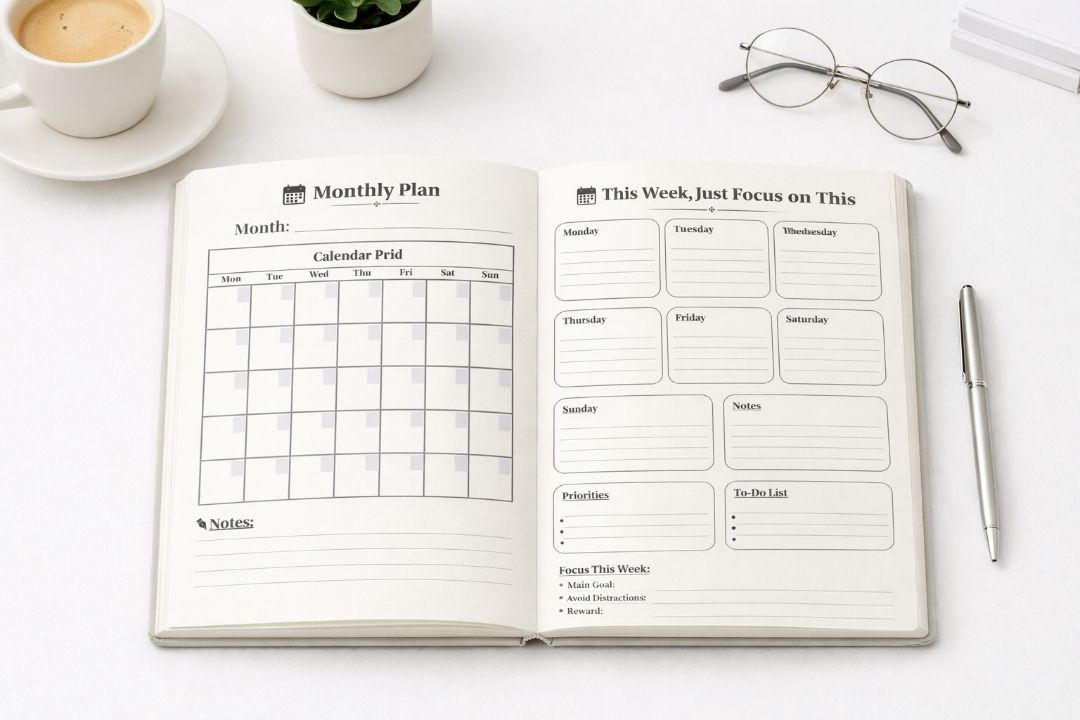
- Monthly Plan: A macro-overview to record exams, assignment deadlines, and projects early, preventing last-minute cramming.
- This Week Just Focus on This & Priorities: The ultimate antidote to multitasking. Isolate a single anchor objective and 3 critical sub-tasks each week.
- Focus Plan Page: Mapped out using Time Blocking to align peak energy hours with demanding study sessions.
- Habit Tracker: Micro-tracking non-negotiables (reviewing notes, reading, sleep) to build compound consistency over time.
- What I Actually Finished & Why I Didn’t Finish: A revolutionary retrospective feedback loop that turns uncompleted tasks into data points for continuous improvement rather than self-
- blame.
4. Part 3: Growth, Recovery, and Long-Term Retention
True academic mastery requires intentional recovery and celebration of milestones to prevent burnout:
- Growth and Reward / My Rewards: Pre-planned treats and milestones earned upon completing rigorous study blocks to maintain motivation.
- Clear Your Mind & Relax and Rest: Dedicated "Brain Dump" and restorative zones to purge cognitive clutter, protect well-being, and boost memory consolidation.
- 7 Days Study Challenge & Small Steps Every Day: Gamified micro-sprints proving that cumulative daily micro-efforts outperform erratic cramming.
- 4 Pages of Interactive Digital/Print Stickers: Aesthetic tabs and icons (exams, project deadlines, priority flags) to make organizing visually engaging.
5. Part 4: Quick Setup Tips & Common Mistakes to Avoid
To maximize the utility of your printable or digital planner, keep these expert tips in mind:
- Common Mistakes to Avoid: Don't overload your weekly focus with 10+ tasks; never skip the reflection pages (Why I Didn't Finish); avoid 24/7 grinding without scheduled rest.
6. Conclusion: Ready to Take the First Step?
Success doesn't begin the night before an exam—it begins with a plan. The Academic Success System provides a clear, organized framework that helps you replace stress with structure, conquer procrastination, and achieve your highest educational aspirations.Whether you're preparing for exams, managing multiple courses, or working toward long-term goals, this planner is designed to help you study with greater confidence, purpose, and consistency.Ready to transform your goals into measurable academic success?
to get your Academic Success System planner today and start engineering your success!
References
- Newport, C. (2016). Deep Work: Rules for Focused Success in a Distracted World. Grand Central Publishing.
Official page:
Deep Work – Grand Central Publishing
- Clear, J. (2018). Atomic Habits: An Easy & Proven Way to Build Good Habits & Break Bad Ones. Avery.
Official website:
- Brown, P. C., Roediger III, H. L., & McDaniel, M. A. (2014). Make It Stick: The Science of Successful Learning. Belknap Press of Harvard University Press.
Official website:
- Ebbinghaus, H. (1885). Memory: A Contribution to Experimental Psychology.
Online edition:
Internet Archive – Memory: A Contribution to Experimental Psychology

Affiliate Disclosure
This post may contain affiliate links. If you purchase through one of these links, I may earn a small commission at no additional cost to you.
6-Hole Loose Leaf Binder Refill Paper - A5/A6/A7
Looking for extra pages to expand your Academic Success System Student Planner? These A5/A6/A7 6-hole loose leaf binder refill papers are a practical addition for students who need more space for study notes, to-do lists, reminders, ideas, and daily planning.
Available in lined and blank formats, these kraft paper sheets can be added to compatible 6-hole binders, making it easy to customize your planner and create additional sections whenever you need them.
Whether you're adding more pages to your Academic Success System or creating a personalized study binder, these refill sheets provide a simple way to keep your notes and plans organized.
Check sizes, styles, and product details
👉 here